
How Are Carbon Fibre Rollers Manufactured?
Carbon fibre rollers are widely used in industrial machinery that requires lightweight components, high stiffness, and reliable performance. Compared with conventional metal rollers, carbon fibre rollers can reduce rotating mass and improve dynamic performance in suitable applications. However, their performance depends not only on the raw materials but also on the manufacturing process.
From material selection and fibre winding to curing, machining, and quality inspection, each production stage plays an important role in the final product. Understanding how carbon fibre rollers are manufactured can help buyers evaluate product quality and choose a suitable supplier.
1. Material Selection
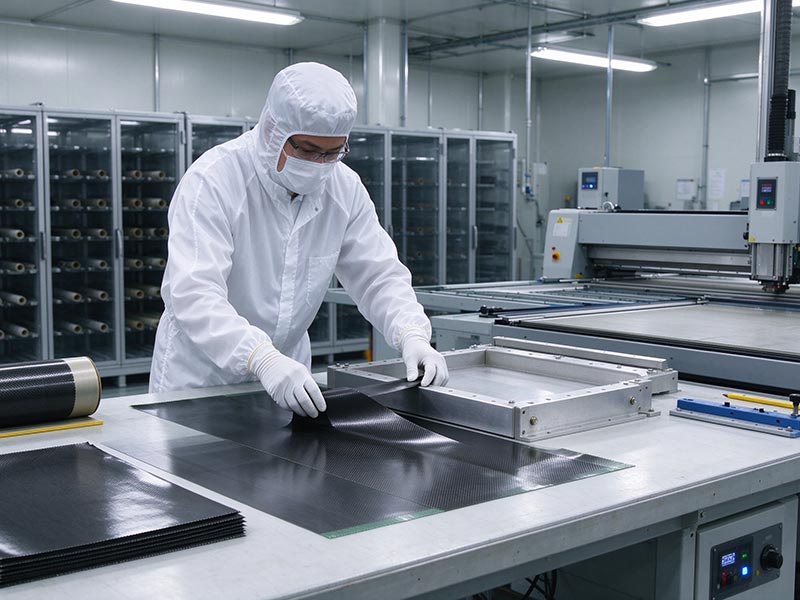
The first step in manufacturing carbon fibre rollers is selecting the appropriate raw materials. Most carbon fibre rollers are made from carbon fibre reinforced polymer (CFRP), a composite material consisting of carbon fibres embedded in a resin matrix.
Carbon fibres provide strength and stiffness, while the resin binds the fibres together and transfers loads throughout the composite structure.
Manufacturers select materials according to the intended application, operating speed, load requirements, and working environment. Fibre grade, resin type, and material configuration can all influence the final roller’s performance.
For example, rollers designed for high-speed machinery may require a structure that balances low weight with sufficient stiffness and dimensional stability.
2. Preparing the Roller Core or Mandrel
After selecting the materials, manufacturers prepare the mandrel or core used to form the roller. A mandrel is a cylindrical tool that supports the composite material during manufacturing and helps establish the roller’s internal diameter and shape.
The mandrel must have suitable dimensions and a properly prepared surface to support consistent production. Depending on the design, the finished roller may be hollow or incorporate additional structural components.
Manufacturers may also plan the installation of metal end fittings, shafts, or other connecting components at this stage. These details are important because the roller must fit the machine and transfer loads effectively during operation.
3. Applying the Carbon Fibre Layers
The next step is forming the carbon fibre structure around the mandrel. Several manufacturing methods can be used, depending on the roller design and production requirements.
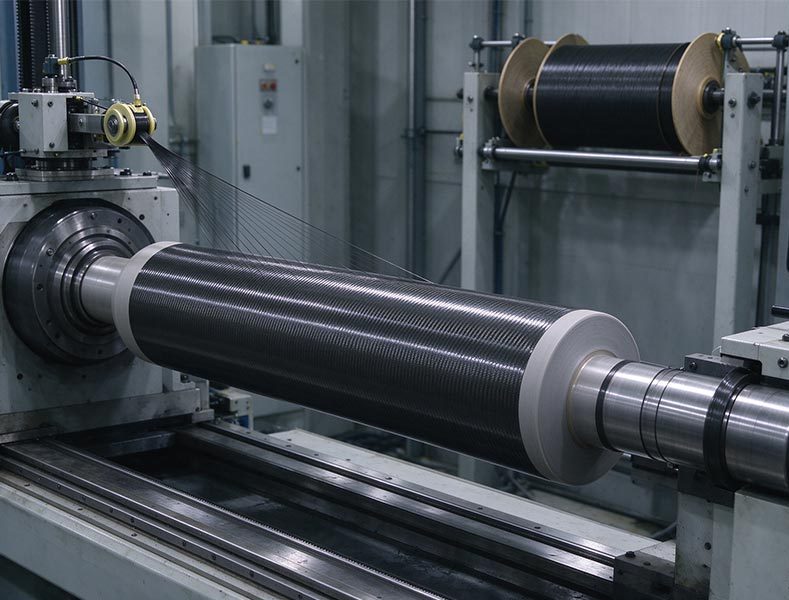
Filament Winding
In filament winding, continuous carbon fibre strands are wound around a rotating mandrel in controlled patterns. Fibre angles and winding tension can be adjusted to achieve specific structural properties.
This method is suitable for producing cylindrical composite components and allows manufacturers to tailor the fibre arrangement to the intended loading conditions.
Prepreg Wrapping
Another method involves wrapping carbon fibre prepreg around the mandrel. Prepreg is carbon fibre material that has already been impregnated with resin.
The layers are arranged according to the design requirements, with fibre orientation selected to balance stiffness, strength, and weight. The wrapped structure is then prepared for curing.
The most appropriate method depends on the roller’s dimensions, required performance, material system, and manufacturing process.
4. Curing the Composite Material
After the carbon fibre layers have been applied, the composite structure must be cured so that the resin forms a solid matrix.
Depending on the material system, curing may take place in an oven or an autoclave under controlled temperature and, where required, pressure. Some manufacturing processes use other curing methods suited to the selected resin.
Proper curing is essential for achieving the intended mechanical properties and maintaining structural consistency. Temperature, curing time, pressure, and other process parameters must be controlled according to the material manufacturer’s specifications.
Inadequate curing or inconsistent processing may affect the quality of the finished composite component.
5. Removing the Mandrel and Machining
Once curing is complete and the composite structure has cooled sufficiently, the mandrel is removed if the design requires it. The roller then undergoes machining and finishing operations to achieve the specified dimensions.
Typical operations may include:
Trimming the roller to the required length
Machining the outer diameter
Preparing the ends for mounting components
Installing or finishing shafts and end fittings
Processing the surface according to application requirements
Dimensional accuracy is especially important for industrial rollers because incorrect dimensions or excessive runout can affect installation and machine performance.
The specific machining operations depend on the roller’s design and the customer’s technical drawings.
6. Surface Finishing and Dynamic Balancing
After machining, the roller may undergo additional surface finishing. Depending on its intended use, the outer surface may require polishing, grinding, coating, or another treatment.
The surface finish should match the material being handled and the operating conditions. For example, certain web-handling applications may require a consistent surface to help maintain stable material movement.
Dynamic balancing may also be necessary, particularly for rollers intended to operate at high rotational speeds. Balancing helps reduce vibration caused by uneven mass distribution.
The required balancing grade and operating speed should be specified according to the application and relevant engineering requirements.
Do you need to replace your current rollers for improved Productivity?
Contact SHUNYI now to learn more about carbon fiber rollers!
7. Quality Inspection and Testing
Before delivery, carbon fibre rollers should undergo inspection to confirm that they meet the agreed specifications.
Depending on the product, quality checks may include:
Dimensional inspection: Verifies diameter, length, and other critical measurements.
Runout inspection: Checks the consistency of the roller’s rotational geometry.
Surface inspection: Identifies visible defects or finishing problems.
Balancing tests: Evaluates dynamic balance when required.
Structural inspection: Uses suitable methods to assess composite integrity when necessary.
Inspection requirements should be established before production begins. Buyers can request relevant quality records and test reports to verify compliance with their technical requirements.
8. Custom Manufacturing for Different Applications
Carbon fibre rollers often require customization to match specific machinery. Buyers may specify the roller diameter, length, wall thickness, fibre orientation, surface finish, operating speed, and end-fitting configuration.
Providing accurate drawings and information about the working load, operating environment, and installation method helps manufacturers determine a suitable design.
An experienced manufacturer can evaluate these requirements and recommend an appropriate material configuration and production process. This is particularly important for replacement rollers and specialized high-speed equipment.
Conclusion
Carbon fibre roller manufacturing involves several carefully controlled stages, including material selection, mandrel preparation, fibre application, curing, machining, surface finishing, and quality inspection.
Each stage contributes to the final roller’s dimensional accuracy, structural performance, and suitability for its intended application. By understanding the manufacturing process, buyers can ask more informed questions and evaluate suppliers more effectively.
If you are sourcing custom carbon fibre rollers, providing detailed technical specifications and discussing quality requirements with the manufacturer can help ensure that the finished product meets your equipment’s needs.
