
Carbon Fibre Roller vs Steel Roller: Which Is Better for Film Production?
As film production lines continue to operate at higher speeds, roller performance has become increasingly important. In blown film machines, bag-making machines, slitting lines, and other web handling equipment, rollers directly affect web tension, product quality, energy consumption, and machine stability.
For decades, steel rollers have been the standard choice because of their strength and relatively low cost. However, with increasing demands for higher productivity and better film quality, more manufacturers are replacing conventional steel rollers with carbon fibre rollers.
So, which option is better for high-speed film production? Understanding the differences between carbon fibre rollers and steel rollers can help manufacturers make the right investment.
Understanding Steel Rollers
Steel rollers are widely used throughout the converting industry. They consist of a steel tube combined with shafts, bearings, and surface treatments such as chrome plating or rubber covering.
Advantages of Steel Rollers
Steel rollers have several benefits:
- High structural strength
- Relatively low manufacturing cost
- Mature production technology
- Suitable for low and medium-speed applications
- Good wear resistance
Because of these characteristics, steel rollers remain common in conventional production lines.
Limitations of Steel Rollers
Although steel rollers provide good strength, their weight creates several disadvantages.
Heavy rollers generate higher rotational inertia, which requires more torque during acceleration and deceleration. This increases energy consumption and puts additional loads on bearings and drive systems.
At higher operating speeds, excessive weight can also lead to:
- Increased vibration
- Roller deflection
- Reduced web stability
- Shorter bearing life
- Higher maintenance costs
These limitations become more obvious as machine speeds continue to increase.
What Is a Carbon Fibre Roller?
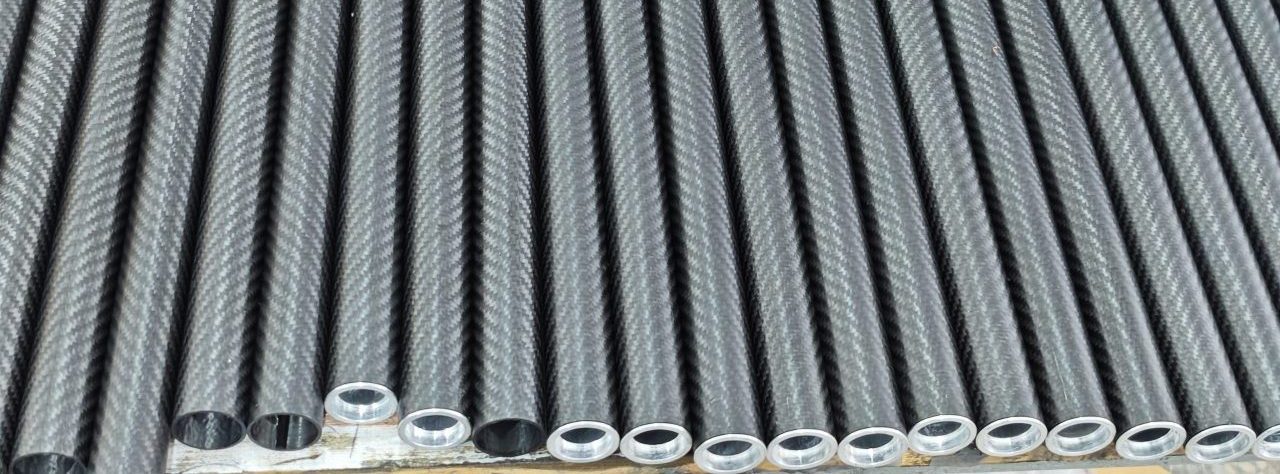
A carbon fibre roller is a lightweight composite roller manufactured from carbon fibre reinforced materials. It is designed to provide exceptional rigidity while dramatically reducing weight.
A typical carbon fibre roller consists of:
- Carbon fibre tube body
- Aluminum end fittings
- Steel journals
- Precision bearings
- Surface coatings or coverings
Unlike traditional steel rollers, carbon fibre rollers combine low weight with excellent stiffness, making them ideal for high-speed web handling applications.
Weight Comparison
Weight is one of the most significant differences between the two materials.
Carbon fibre rollers are typically 60% to 80% lighter than steel rollers of the same dimensions.
| Roller Size | Steel Roller Weight | Carbon Fibre Roller Weight |
|---|---|---|
| Ø100×1500 mm | 28 kg | 8 kg |
| Ø150×2000 mm | 70 kg | 20 kg |
| Ø200×2500 mm | 130 kg | 38 kg |
Because of the lower weight, carbon fibre rollers provide several advantages:
- Easier installation
- Faster acceleration and deceleration
- Lower motor loads
- Improved machine responsiveness
Dynamic Performance at High Speed
High-speed film production requires stable roller rotation.
When a heavy steel roller rotates at high speed, centrifugal force and imbalance can produce vibration. Excessive vibration negatively affects web tension and may lead to wrinkles or poor winding quality.
Carbon fibre rollers offer superior dynamic performance because of their low mass and high rigidity.
Benefits include:
- Reduced vibration
- Smoother operation
- Better tension control
- Improved film quality
- Higher machine speed capability
For modern blown film and bag making machines operating above 300 m/min, dynamic performance becomes increasingly important.
Energy Consumption
Energy efficiency has become an important concern for manufacturers.
Because steel rollers have greater mass, motors must deliver more torque to rotate them. This increases power consumption and operating costs.
Carbon fibre rollers reduce rotating mass significantly.
Lower inertia means:
- Reduced startup torque
- Lower energy consumption
- Faster speed adjustments
- Improved overall efficiency
For production lines containing multiple rollers, the cumulative energy savings can be considerable.
Bearing Life and Maintenance
Heavy rollers place greater loads on bearings and shafts.
Over time, excessive loads accelerate wear and increase maintenance frequency.
Common problems associated with heavy rollers include:
- Bearing failure
- Shaft wear
- Increased vibration
- Unexpected downtime
By reducing roller weight, carbon fibre rollers decrease mechanical stress throughout the system.
This contributes to:
- Longer bearing life
- Lower maintenance costs
- Reduced downtime
- Increased machine reliability
Surface Treatment Options
Carbon fibre rollers can be customized with various surface finishes according to application requirements.
Hard Chrome Plating
Provides excellent wear resistance and corrosion resistance.
Suitable for:
- Guide rollers
- Idler rollers
- General film transport
Teflon Coating
Offers anti-stick properties.
Ideal for:
- Adhesive films
- Heat-sensitive materials
Rubber Covering
Improves traction and grip.
Commonly used for:
- Nip rollers
- Pull rollers
- Drive rollers
Ceramic Coating
Provides superior wear resistance for demanding applications.
Cost Comparison
Steel rollers generally have lower initial costs.
However, total ownership cost should also consider:
- Energy consumption
- Bearing replacement
- Maintenance expenses
- Downtime losses
- Productivity improvements
Although carbon fibre rollers require a higher initial investment, many manufacturers achieve long-term savings through increased efficiency and reduced maintenance.
Do you need to replace your current rollers for improved Productivity?
Contact SHUNYI now to learn more about carbon fiber rollers!
When Should You Upgrade to Carbon Fibre Rollers?
Carbon fibre rollers are particularly beneficial when:
- Production speed exceeds 300 m/min
- Roller lengths are large
- Vibration problems occur
- Film wrinkles affect product quality
- Bearing failures are frequent
- Energy efficiency is important
For modern high-speed film production lines, carbon fibre rollers provide significant advantages over conventional steel rollers.
Conclusion
Both steel rollers and carbon fibre rollers have their place in industrial applications. Steel rollers remain a practical solution for many standard processes.
However, for high-speed blown film and bag making machines, carbon fibre rollers offer superior performance in terms of weight reduction, vibration control, energy efficiency, and web stability.
As manufacturers continue to pursue higher productivity and lower operating costs, carbon fibre rollers are becoming an increasingly attractive solution for modern film converting industries.
Investing in lightweight composite rollers is not only an upgrade in materials but also an investment in efficiency, product quality, and long-term competitiveness.
